AlUla Travel Guide — When to Go, What to See, How to Plan
AlUla is a governorate in north-west Saudi Arabia, part of the Medina region, where a green farming valley meets sandstone mountains and archaeological sites spanning thousands of years. This guide answers the questions that come up before every visit: when to go, how to get there, what to see, and how many days you really need.
When is the best time to visit AlUla?
The best time to visit AlUla is the cool season from October through March, when daytime conditions suit moving between archaeological sites and being outdoors, and nights turn noticeably cold — especially in December and January. From June to August the midday heat is intense; visiting is still possible, but field activities are scheduled for early morning or the hours before sunset.
- October – November
- Mild and suitable for every activity; the season opens and demand climbs.
- December – February
- Peak season; pleasant days and cold nights — bring a warm layer for evenings and camping.
- March
- The tail of the cool season, comfortable for walking and photography.
- April – May
- Heat builds gradually; morning activities work best.
- June – September
- Hot months; favour early morning or pre-sunset, with evening activities dominating.
Desert nights are far colder than the days throughout the season — an extra layer for the evening is essential even after a sunny afternoon.
How do you get to AlUla?
AlUla is served by AlUla International Airport (ULH), which receives domestic flights from Riyadh and Jeddah, with additional seasonal services at the height of the season. The most common overland route is from Medina — the closest major city, roughly 300 kilometres away, about three and a half hours by car on paved roads.
- By air
- AlUla International Airport (ULH) — domestic flights from Riyadh and Jeddah, plus seasonal additions in peak months.
- From Medina
- About 300 km — roughly 3.5 hours by car; the nearest major city.
- From Riyadh
- Flying is considerably faster than the long overland drive.
- Getting around AlUla
- Sites are spread along the valley; a car or organised transfers are necessary.
The sites: what to see in AlUla
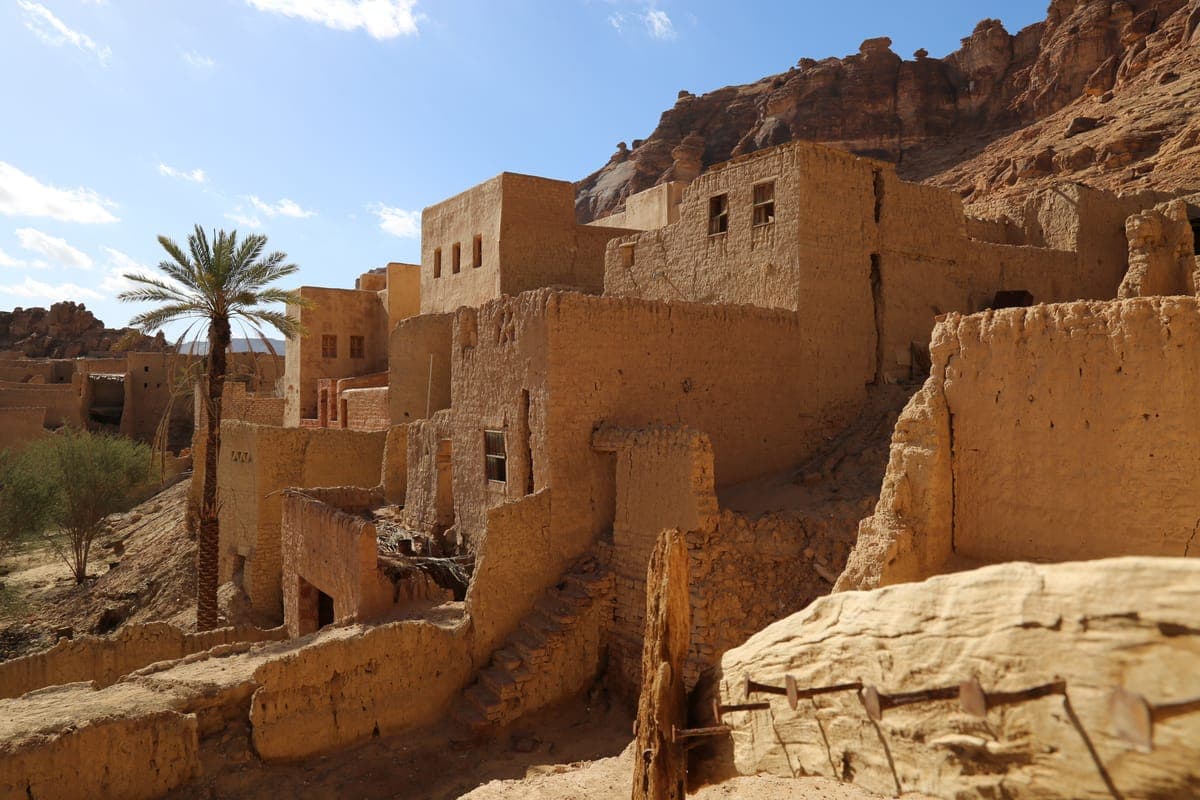
AlUla's best-known site is Hegra (Madain Salih), the first Saudi site inscribed on the UNESCO World Heritage List, with more than a hundred monumental Nabataean tombs cut into the rock. Around it sit older and newer layers: the kingdoms of Dadan and Lihyan, the inscriptions of Jabal Ikmah, the mud-brick AlUla Old Town, and contemporary architecture such as Maraya.

- Hegra (Madain Salih)
- The first Saudi site on the UNESCO World Heritage List; over a hundred monumental Nabataean tombs.
- Jabal Ikmah
- A dense concentration of ancient inscriptions, described as an open-air library and listed on UNESCO's Memory of the World register.
- Dadan
- Capital of the kingdoms of Dadan and Lihyan — a layer older than the Nabataean presence.
- AlUla Old Town
- A tight mud-brick fabric of hundreds of houses, with a prepared visitor route.
- Elephant Rock (Jabal AlFil)
- A natural sandstone formation shaped like an elephant — a favourite sunset and photography spot.
- Maraya
- A contemporary mirror-clad hall, recognised by Guinness World Records as the largest mirrored building.
- Sharaan Nature Reserve
- A rewilding reserve that includes an Arabian leopard programme.
How many days do you need in AlUla?
Two to three days is the comfortable length for a first visit to AlUla: one day for the major archaeological sites, one for the Old Town, the valley and an evening experience, and a third for nature and trails — or simply for a slower pace. A single day covers only a selected thread, which means leaving sites out rather than rushing all of them.
- One day
- One chosen thread — Hegra, or the Old Town and the valley — without trying to cover everything.
- Two days
- The major archaeological sites plus the Old Town, the valley and an evening experience.
- Three days
- Adds nature and trails, and more room for photography and a slower rhythm.
- More than three
- Suits walking, camping and specialised experiences without schedule pressure.
Distances between sites consume more time than visitors usually expect — build transfer time into the schedule, not around it.
Practical questions before you go
Visiting does not require a permit specific to AlUla; what you need is lawful entry to Saudi Arabia, then tickets for the heritage sites, which are visited on organised tours. Comfortable, modest clothing works best, together with footwear for walking on sand and stone, and sun protection in every season.
Tickets and entry requirements change by season — confirm them with official sources before travelling.
We write your chapter in AlUla
From a private journey shaped around your days, to a published group departure, to a short experience in a single evening — organisation, guides and transport by CHAPTERS.