Private AlUla Tour or Group Tour? How to Choose the Right Experience
The best way to explore AlUla is not the same for every visitor. One traveller may value a private vehicle, an adaptable pace and time to focus on a particular interest. Another may prefer a published group departure with a clear meeting point, a shared guide and no need to design a day from scratch. Neither format is automatically better. The right choice depends on who is travelling, how much time you have, what you want to learn or experience, and which compromises you are comfortable making. Privacy, flexibility, sociability and budget all matter, but they rarely matter equally.
An editorial guide by the CHAPTERS TOUR team — AlUla
This decision deserves attention in AlUla because a visit can involve heritage sites, natural landscapes, cultural districts and experiences with their own operating schedules. A long list of stops does not guarantee a good day. Realistic timing, clear inclusions, appropriate transport and a pace that suits the guests usually matter more.
This guide compares a private AlUla tour with a group tour in AlUla in practical terms. It does not assume a particular price, route or availability. Instead, it gives you a framework you can apply to any current proposal or published departure.
The short answer
Choose a private tour when control over pace, privacy or personalisation is essential to the trip. Choose a group tour when a published route already fits your interests and you prefer a straightforward booking with shared operating costs. In both cases, read the itinerary, meeting arrangements, inclusions and change terms before confirming.
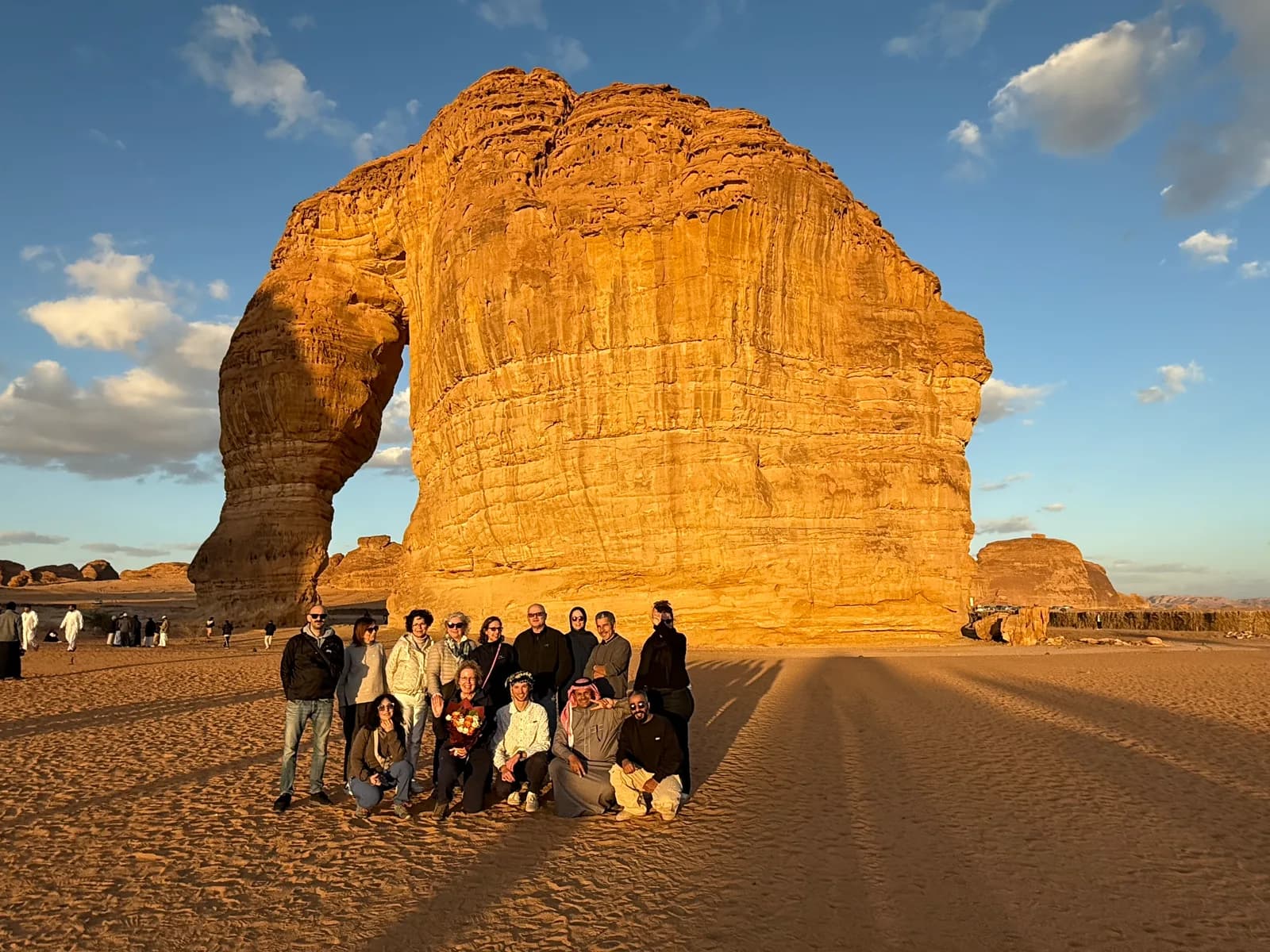
Visitors at Elephant Rock in the last light of the day
01
What is the difference between a private and group tour?
The central difference is not necessarily what you see. Private and group itineraries may include similar areas, yet feel completely different because of who joins, who controls the timing and how the day is managed.
What is a private AlUla tour?
A private tour is reserved for one booking party. That may be one traveller, a couple, a family, a group of friends or an organisation. Guests from unrelated bookings do not normally join unless the proposal says otherwise.
The itinerary may be created around the guests or adapted from an established route. A strong private proposal should explain what is genuinely tailored: perhaps the start time, sequence of stops, language, walking pace, transport arrangement or the depth of interpretation.
“Private” should not be confused with unrestricted access. A dedicated guide and vehicle do not mean a heritage site is closed to other visitors. Sites and experiences continue to operate under their own schedules, capacities and rules. Any exclusive space or access should be described and confirmed explicitly.
Private also does not have to mean elaborate or luxurious. It can be a simple, focused arrangement that removes unnecessary complexity for one party. The value lies in control, clarity and attention, not in labels.
What is a group tour in AlUla?
A group tour is a scheduled departure with a published route, start time, meeting point and approximate duration. Travellers from separate bookings join the same guide or operating team and move through the day together.
The route is usually less adaptable because a change for one person affects everyone. That structure can be an advantage. It gives the traveller a clear product to assess, makes preparation easier and reduces the amount of planning required before arrival.
Shared operation can also make a group departure more efficient for solo travellers, couples and small parties. Costs such as guiding, coordination and transport may be spread across more participants. That does not guarantee that every group tour costs less than every private one; inclusions and logistics still need to be compared.
Group quality is influenced by size, guide-to-guest balance, transport, time management and how clearly expectations are set. A well-run small-group day can feel calm and personal. A poorly planned private booking can still feel rushed.
Start with the outcome, not the category
Before looking at products, write down three things you want from the day. You might care about deeper historical context, a comfortable pace for children, a social atmosphere, photography time or a simple all-in-one schedule.
Then identify the priority you would least like to sacrifice. Trying to secure maximum privacy, maximum flexibility and the lowest possible cost at the same time usually leads to an unhelpful comparison.
If you want a more detailed framework for assessing tailored proposals, read the guide to choosing a private AlUla journey.
A private format becomes valuable when the people travelling together have needs or goals that a fixed departure cannot reasonably serve. The purpose is not to change every detail during the day. It is to plan around the guests before the itinerary is confirmed.
Your schedule has fixed constraints
A short stay, an arrival later in the day, an important dinner or another commitment may make a standard departure difficult. A private arrangement can be coordinated around those constraints, subject to the operating times and availability of each component.
This is particularly useful when timing is part of the experience, such as photography or a personal occasion. The important step is to communicate that need early. A timetable cannot always be rearranged after tickets, guides and transport have been confirmed.
Your party needs a different pace
Families with young children, guests travelling with older relatives and people who need more rest or mobility support often benefit from a private rhythm. Stops can be sequenced more carefully, and the day can include sensible time for boarding, walking and breaks.
Private planning does not remove the physical characteristics of a site. Ask about surfaces, walking distance, exposure, standing time and available access arrangements. Personalisation helps you choose and pace the day; it cannot make every location suitable for every need.
You have a focused interest
Some visitors want detailed archaeological context. Others are primarily interested in landscape, photography, design, food or local culture. A private tour can give one subject more space instead of distributing attention evenly across a general highlights route.
For example, Hegra is recognised by UNESCO as a World Heritage property and should be visited within the rules and operating arrangements that protect it. A private guide may adapt the depth and style of interpretation, but cannot override official controls.
Privacy is part of the purpose
A couple marking an occasion, a family reunion, an executive delegation or guests who prefer not to share transport may value privacy in practical ways. It can make conversation easier, reduce social pressure and give a host more control over photography and communication.
Ask what privacy includes. Is the vehicle dedicated? Is the guide assigned only to your party? Are meals or activity spaces shared? Are photographs taken by the operating team? A precise definition is more useful than a premium-sounding label.
Your party is already a complete group
For a sizeable family or group of friends, a private format may simplify the entire booking. Everyone receives one meeting plan, follows one communication channel and stays together through the main parts of the day.
Capacity still matters. A proposal should explain the actual transport arrangement, whether the group will be divided, how many guides or coordinators are involved and who takes responsibility on the ground.
The experience is part of a corporate programme
Company visits and team programmes often have dependencies beyond sightseeing: airport movements, meeting times, hospitality, participant communication, branding or internal objectives. A private programme can be fitted into the larger schedule and managed through one operational brief.
For this type of visit, explore the CHAPTERS corporate journeys in AlUla. A team brief usually requires more detail than a set of seats on a public departure.
A group departure is often the most sensible way to explore when the published product already answers your needs. Choosing it is not a compromise in quality; it can be an efficient and enjoyable decision.
You want an easy, well-defined booking
A clear route, time and meeting point reduce decision fatigue. Instead of creating a new plan, you can compare available departures, select the one that suits your dates and prepare for the day.
This is useful on a first visit or a short stay, especially when you are already coordinating flights, accommodation and other experiences. The tour becomes one stable part of a larger itinerary.
Budget efficiency matters
Shared departures can distribute operating costs among several bookings, which often makes them attractive for solo travellers, couples and small parties.
Compare like with like. A seat price may or may not include transport from your accommodation, tickets, refreshments or meals. Add any separate transfers and required extras before deciding which format offers better value.
You are travelling alone
A group tour gives a solo traveller access to an organised day without having to form a party. It can also create a relaxed opportunity to meet people with a shared interest in the destination.
If you need long periods of silence, detailed photography stops or specialist interpretation, ask about group size and pace. Some shared experiences are intimate; others are designed to move efficiently through a fixed route.
You enjoy a social atmosphere
Shared questions and observations can enrich a guided visit. A capable guide can turn different viewpoints into a useful conversation while keeping the day focused.
The social element works best when participants respect time and privacy. Do not assume other guests want to appear in photographs or have their images shared.
The published itinerary already fits
If the route, duration, language and meeting arrangement align with your plans, paying for unused customisation serves little purpose. Book the group option and use your independent time for a meal, neighbourhood walk or short experience.
Browse the current AlUla journeys and the scheduled group departures to compare what is actually available. Routes and dates can change, so the live product page should remain the booking reference.
This table describes the usual pattern. Always check the current proposal because individual products can differ.
Factor
Private AlUla tour
Group tour in AlUla
Flexibility
More scope to shape timing, pace and emphasis before confirmation
Route and schedule are shared and usually fixed
Privacy
One booking party normally travels together
Travellers from different bookings participate
Cost
The private party covers the arrangement
Operating costs are often shared across participants
Time
Breaks and pace can be planned around the party
Everyone follows one timetable
Party size
Works for couples, families, friends, delegations and teams
Often suits solo travellers, couples and flexible small parties
Overall feel
Personal, focused and controlled
Structured, social and easy to select
Flexibility
Private planning lets you decide which elements deserve more time before the day is finalised. It can also help align pickup and return with the rest of your itinerary.
On a group departure, individual flexibility is limited because the route belongs to all participants. Operational changes may still occur, but one guest would not normally be able to replace a stop or delay the whole group.
Be realistic in both cases. Tickets, site slots, transport and guide schedules create boundaries. “Flexible” means thoughtfully adaptable, not consequence-free.
Privacy
Private touring can make conversation, family logistics and photography more comfortable. It is especially useful when guests are hosting others or discussing matters they would not want to share in a public vehicle.
A group tour involves shared time and space. That may be exactly what a sociable traveller wants, but it can feel less suitable for a personal event or a party with sensitive needs.
Cost
There is no reliable universal figure for either option. Private pricing can vary with party size, duration, transport, tickets, meals, guiding and extra arrangements. Group tours usually present a per-person amount, but inclusions differ.
Build a total for your party. Include required transfers, tickets or meals that sit outside the headline booking. As a private party grows, the cost relationship may change, but only the actual proposal can show whether it is competitive.
Time
A private schedule may provide slower transitions, a later start or more focused interpretation. A group timetable provides discipline and predictability, which some travellers value more than adaptability.
Neither format can ignore official operating times. The strongest itinerary builds around confirmed constraints rather than treating them as an inconvenience.
Number of people
Group touring is often a natural starting point for one or two visitors. Families and friends need to weigh total cost against the value of staying together and setting their own pace.
Large parties and organisations usually require dedicated planning even if the activity itself is collaborative. Arrival waves, transport capacity, communication and safeguarding become operational questions.
The overall experience
A private tour is a story built around one party. A group tour invites you into a clearly defined story shared with others.
The category alone cannot tell you which one is better. Group size, guide role, language, transport, inclusions and change terms are more reliable indicators of the day you will actually have.
05
Five traveller profiles and the best fit for each
1. A couple: decide whether the occasion or the itinerary comes first
For an anniversary or a trip where privacy and unhurried photography matter, a private tour is usually the closer fit. The pace can leave room for conversation and quiet rather than trying to maximise the number of stops.
If the couple mainly wants an organised introduction to AlUla and a published route suits their plans, a group departure is practical. They can keep the rest of the day independent.
Recommendation: private for an occasion or privacy-led day; group for a first overview and a clearly defined budget.
2. A family: ages and energy levels should drive the decision
A family may contain very different travellers. Young children, teenagers and older relatives do not always move at the same pace. A private plan often works better when rest, meal timing, child seats or reduced walking are essential.
A group tour can suit a family with older children who are comfortable following a timetable. Ask about duration, walking, age requirements and group size rather than relying on a generic “family-friendly” label.
Recommendation: private when needs vary; group when the whole family can comfortably follow the published plan.
For a more detailed age-based framework, see the guide to AlUla with children.
3. Friends: compare the purpose of the trip with the total cost
Friends celebrating together may get more value from keeping the day private. A dedicated arrangement protects the group dynamic, simplifies pickup and gives them space for photographs and shared moments.
A small party that mainly wants a guided overview may find a group departure more efficient. Check that enough seats are available together and that the friends will not be split between departure times or vehicles.
Recommendation: private for a celebration or a larger established party; group for flexible friends who want a ready-made day.
4. A solo traveller: group first, private for a specific purpose
For most solo visitors, a scheduled group tour is the natural starting point. It provides coordination, shared guiding and temporary company without requiring the traveller to assemble a party.
A private tour becomes worthwhile when the traveller has a precise research, photography or professional objective, or a schedule that cannot align with published departures. The customisation should solve a real problem.
Recommendation: group for a general visit; private for specialist interests or unusually tight timing.
5. A company or team: dedicated planning is usually essential
A corporate visit has more moving parts than an ordinary leisure booking. It may include meetings, guest management, hospitality, internal communication and a defined purpose for the team.
A dedicated programme is usually the better fit, even when one component is a group activity. The proposal should identify capacity, responsibilities, transport, the operational contact and realistic alternatives.
Recommendation: a private programme designed for the organisation rather than separate seats on a public tour.
06
Common mistakes when choosing a tour format
Booking private because the label sounds superior
Private touring has value when you use its flexibility or privacy. If a published route already fits perfectly, customisation may add little. Identify the specific need that the private format will solve.
Booking group on price alone
The seat price may exclude transfers, meals or other elements you require. Read the full list and compare the cost of the complete day rather than one number.
Not asking about group size
“Group” does not reveal how many people may join, and “private” does not reveal capacity. Ask for the expected arrangement when comfort, pace or guide access matters.
Assuming a private itinerary can change at any moment
Some components depend on fixed slots and supplier commitments. The best time to personalise is before confirmation. Ask when material changes need to be finalised.
Ignoring walking and access needs
A beautiful route can still be unsuitable for a particular party. Ask about terrain, exposure, standing, transfers and rest opportunities. Do not assume a vehicle reaches every point.
Choosing a crowded itinerary to prove value
More stops can mean less attention. Constant movement reduces the time available to understand or enjoy a place. Prioritise what matters and leave room for natural delays.
Skipping the change and cancellation terms
Tour delivery may involve reservations with sites, guides, transport providers and other partners. Understand the published terms before paying and ask what happens if the date or party size changes.
A photograph may show a vehicle, meal or setting that is not part of every booking. The written proposal and confirmed inclusions are the reference.
07
How to make the final decision
Use this simple rule:
■Choose a private AlUla tour when the success of the day depends on flexibility, privacy, mixed ages, a specialist interest or a schedule connected to an occasion or company programme.
■Choose a group tour in AlUla when the published route already fits, you want an easier decision, you enjoy a social atmosphere and you prefer a clear per-person arrangement.
■Ask for more detail when group size, transport, inclusions, walking level or change terms are unclear.
The CHAPTERS TOUR team can help you assess both formats without assuming that one is automatically right. Browse the AlUla journeys and experiences, or start designing your trip with your dates, party size and priorities so the recommendation is based on how you actually want to travel.
Is a private AlUla tour always better than a group tour?
No. A private tour is better when personalisation, privacy or a different pace is important. A group tour is better when the scheduled route suits you and you value a straightforward, shared arrangement.
Is a group tour suitable for a first visit to AlUla?
It can be an excellent introduction if the itinerary covers your interests and the duration, meeting point and walking level work for you. Do not assume one tour covers every major site.
Does “private” mean exclusive access to sites?
No. It may mean a dedicated guide, vehicle and itinerary, but sites continue to follow their own rules, capacity and schedules. Any exclusive access must be stated and confirmed separately.
Which option is cheaper?
Group tours are often more efficient for solo travellers and small parties because some operating costs are shared. There is no absolute rule. Compare total cost and exact inclusions for the current options.
Can I change a group itinerary?
The route and timing are usually fixed to protect the experience of all participants. The operator may make operational changes, but one guest cannot normally redesign the day. Ask before booking if a particular stop is essential.
What should I provide when requesting a private tour?
Share your dates, party size, children’s ages, arrival and departure times, interests, preferred pace, language and any mobility, dietary or health information that affects planning.
Are group tours suitable for children?
It depends on duration, walking level, departure time, age policy and the child’s ability to follow a shared pace. Request an answer for the exact departure you are considering.
How can I tell whether a private tour is genuinely tailored?
The proposal should show what changed because of your brief: timing, sequence, pace, language, transport or depth of interpretation. If it is a generic route with a private label, ask for clarification.
What should I ask about transport?
Confirm pickup and return points, vehicle category, capacity after luggage, who drives and whether transport is only within AlUla or includes travel from another city.
What if I still cannot decide?
Send the same short brief to the travel designer: party size, available time, priorities and preferred budget range. Ask for one scheduled option and one private option that answer the same needs. That creates a fair comparison.
Send one brief and compare both formats against your own trip
Share your dates, party size and priorities for the day, then ask for one published option and one private option built on the same brief so the comparison is fair.